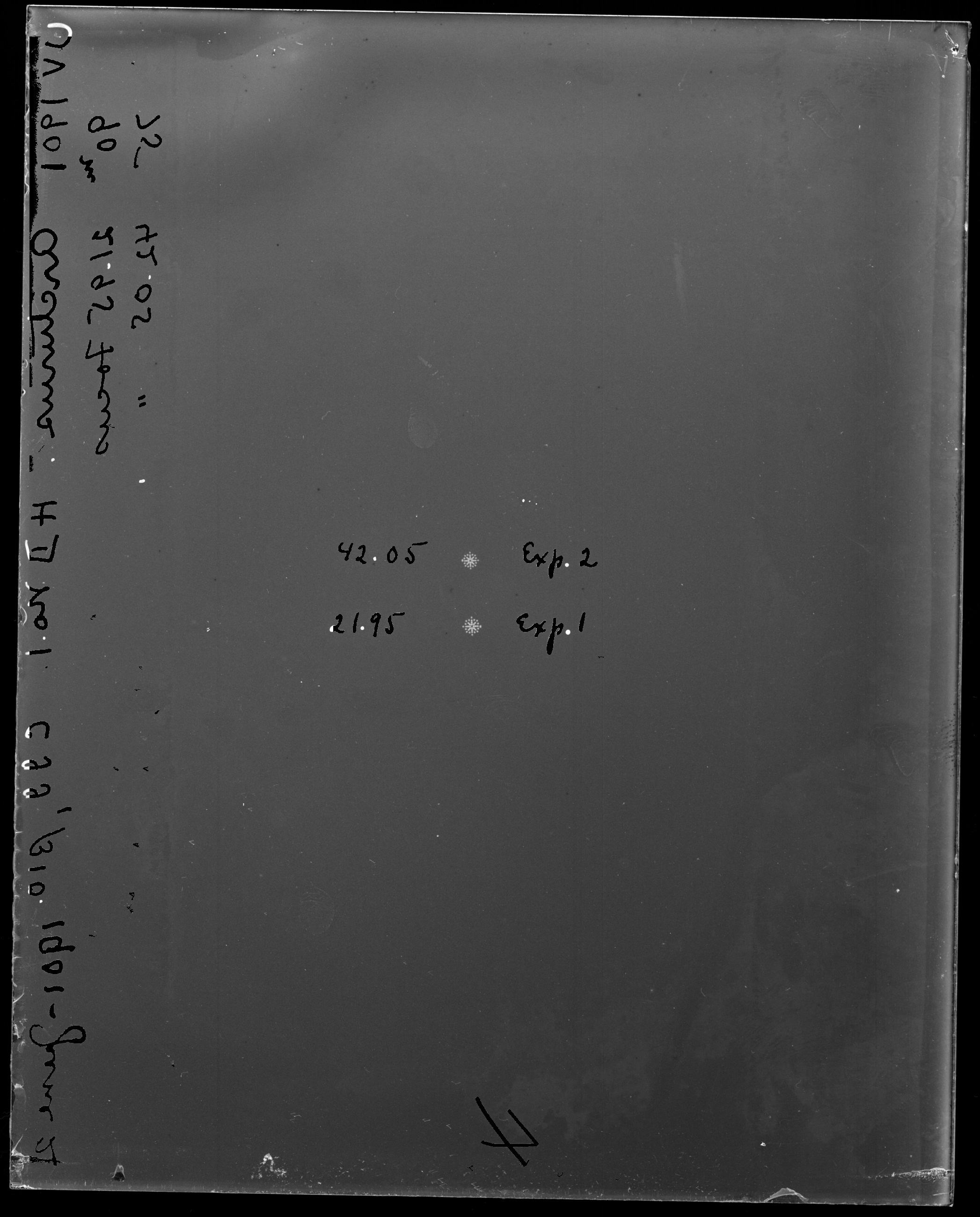
GLASS / PLATE LAB
Specimen 08 / 14 · collaborator edition

UV1901

Two structured photographic targets, not yet a sky field.

Unresolved field

Two small rosette-like images and their labels are the main evidence. They are protected from the annotation mask, but their physical interpretation and celestial identity remain unknown.

Original scan
4,955 × 6,153 px
Source data
16-bit TIFF
Angular scale
Not established
Sky footprint
Not established
01Complete scan, with its stored orientation retained. Display derivative: recorded 1st–99.7th percentile linear stretch, 8-bit JPEG, reduced for sharing. Click any inspection image to enlarge; click again inside the viewer for its native display pixels.
01 /

What is photographic, and what is written?

Two structured photographic targets; no validated sky WCS.

The apparent Arcturus label, June 1901 date, two exposure labels and focus settings support a focus or image-quality experiment. The two target images are protected in the writing mask. They are evidence to analyze as structured images rather than a miniature star field; physical focus units and instrumental interpretation remain unverified.
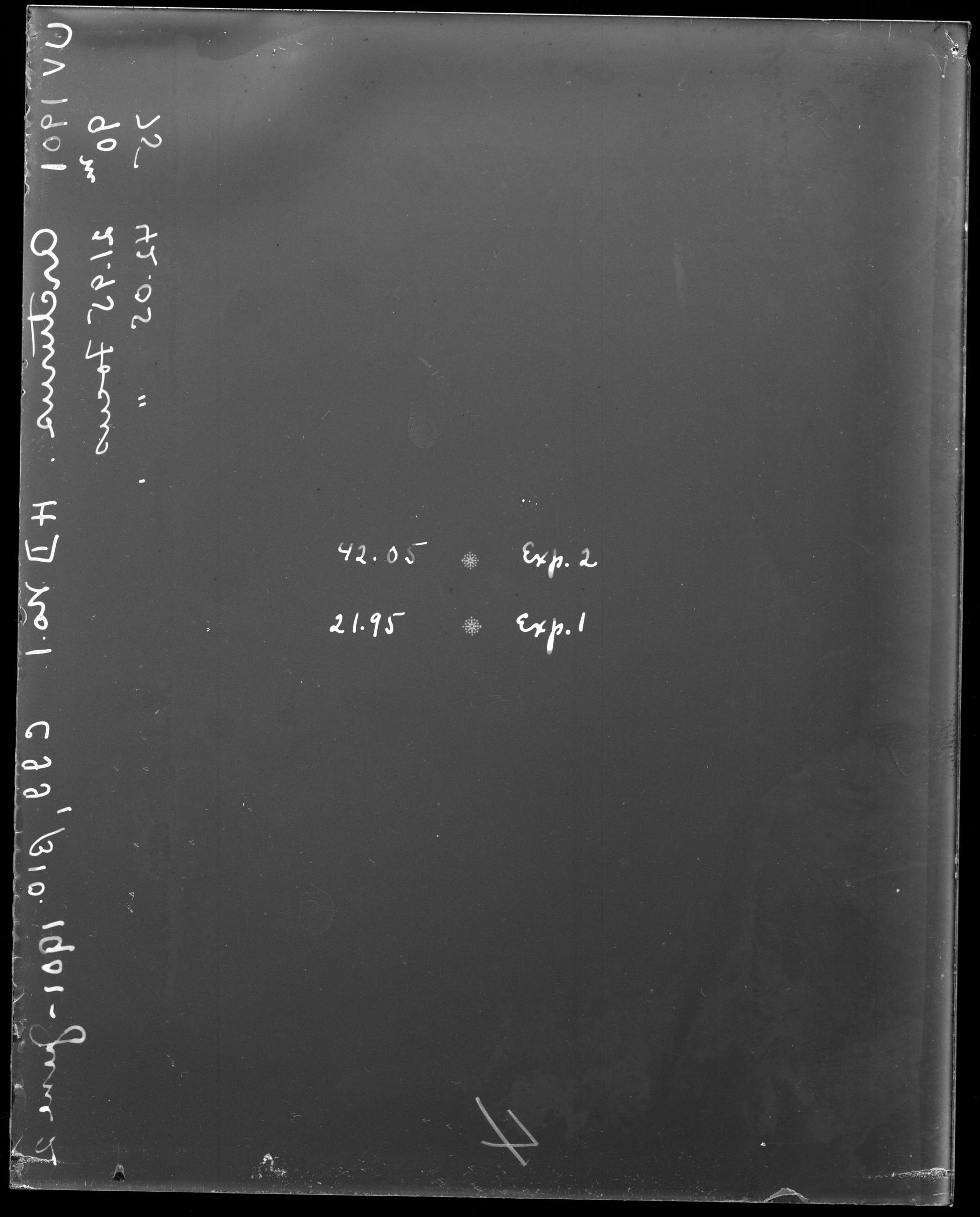
Two protected photographic structures

The regions associated with “Exp 1” and “Exp 2” contain structured, rosette-like images. Their shapes should not be treated as pen strokes merely because they are extended.

Arcturus and focus notes in the margin

The enlarged margin appears to name “Arcturus”, a date beginning “1901 June”, and “Focus” beside 21.95 and 42.05. The internal images are labeled “Exp 1” and “Exp 2”. These readings support a focus-test hypothesis, but the units, exact date and target identity remain unverified; the numbers are not used as angular measurements or magnitudes.

The central photographic crop preserves the two structured target images for morphology inspection.
The readable margin appears to name Arcturus and a 1901 June date, with focus notes beside 21.95 and 42.05. No physical focus unit is assigned.
02 /

Separate the observed layers.

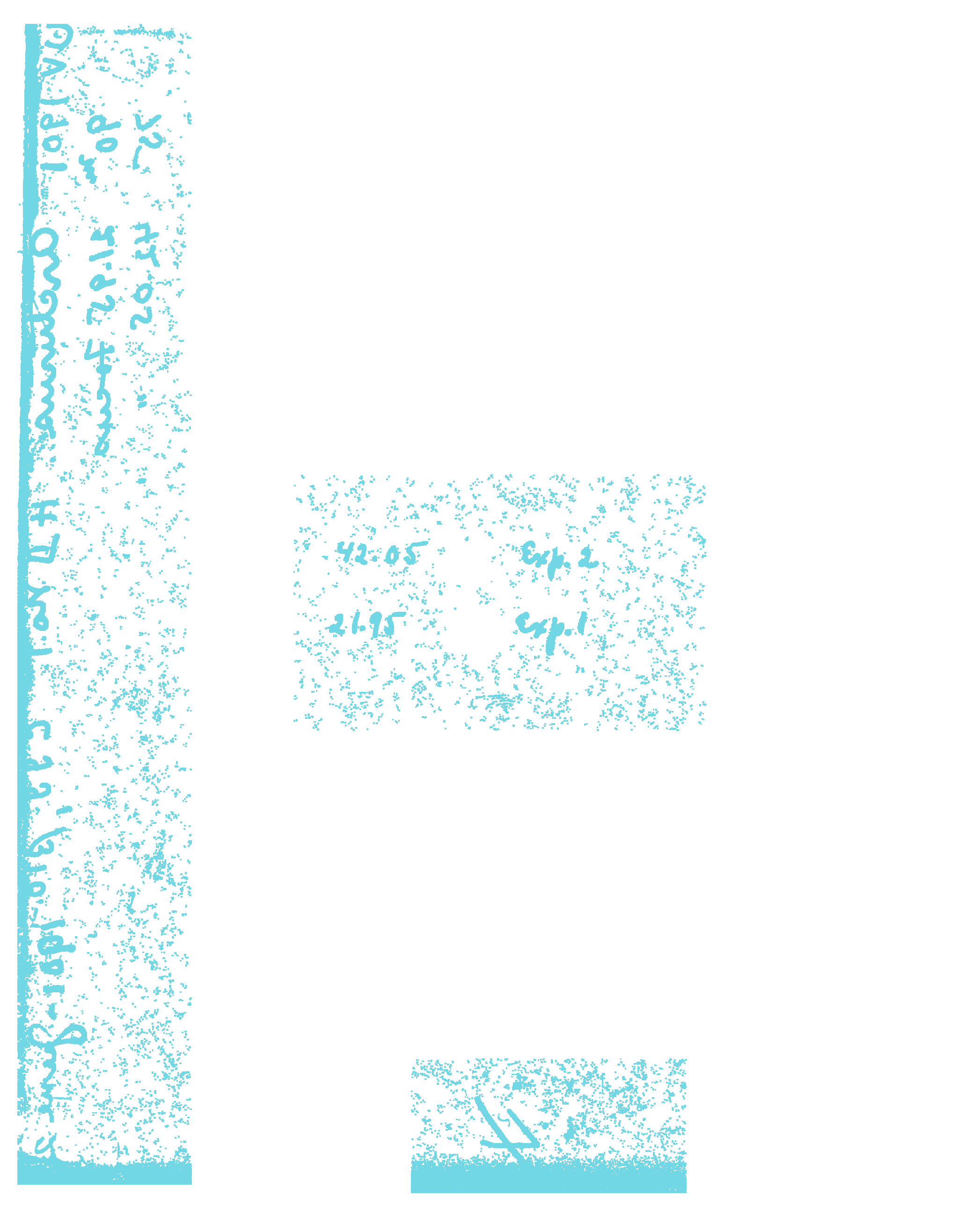
The revised layer uses local contrast in both polarities, expanded inspected writing regions and contextual recovery of short fragments and round digits. Known photographic targets and sampled spectral apertures are protected. It is not OCR and does not reconstruct hidden sky or invent pen strokes.

The selection covers 2.54% of this scan (775,711 pixels). Faint marks, scratches and contacts between ink and photographic images remain ambiguous. The cyan overlay shows the wider exclusion footprint used by the photographic remainder; the stroke mask is supplied separately.

Original scan with candidate annotation selection in cyan
Cyan shows the expanded exclusion area, including edge padding. Move the slider to inspect boundaries and incidental selections.

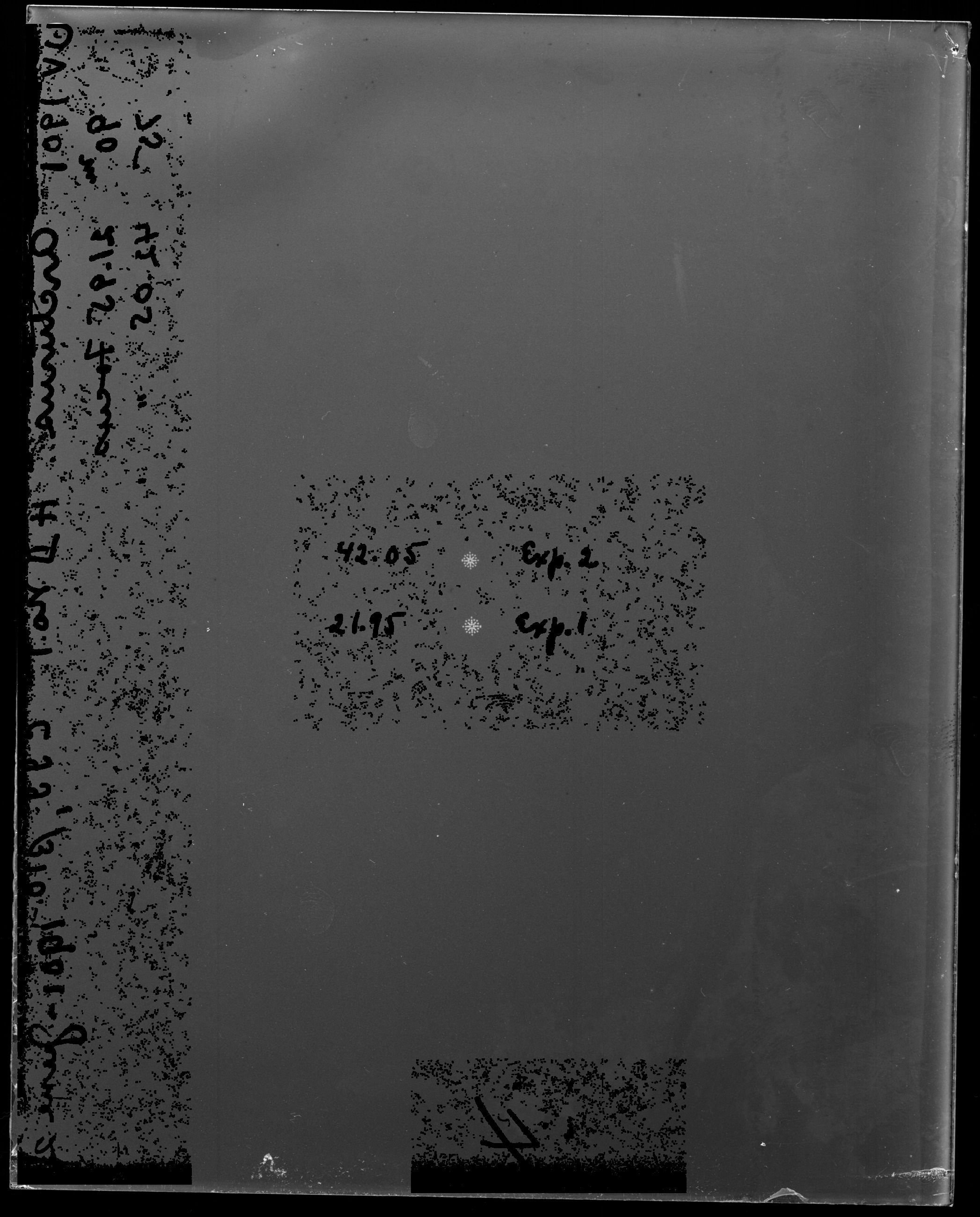
The writing PNG is a white, contrast-rendered stencil of bright and dark observed marks. The observed-pixel PNG preserves their stretched scan appearance. Both use original scan coordinates. The photographic remainder displays excluded pixels as black holes. It is neither a clean-sky reconstruction nor a new photometric product. Keep the mask alongside any measurements. Native original-intensity TIFF/FITS products, where generated, remain in the analysis workspace and are not duplicated in this handoff.

Annotation revision 2

This revision recovers short letter fragments, round digits and inspected dark marks, with broader writing regions. The stroke selection grows from 321,571 to 775,711 pixels (2.41×). The photographic remainder uses a separate 3-pixel exclusion margin, covering 6.38% of the scan.

The wider selection deliberately favors removing writing. Nearby stars, scratches and ambiguous fragments can also be excluded. Explicit photographic protection regions retain known target images and sampled spectra; this does not establish perfect separation elsewhere.

Previous photographic remainder at left; revised remainder at right. Black pixels are excluded, not restored sky. Both panels show the same scan. The native stroke and exclusion masks are supplied separately.
Previous mask ←→ Revised exclusion
Photographic remainder using expanded exclusion maskPrevious photographic remainder revealed at left
03 /

What the search can establish.

There is no confirmed star-field solution. Two target images do not supply enough independent reference positions to determine an unconstrained celestial transformation.

No justified sky position is available for this specimen. A catalog image would imply a location the evidence has not established, so none is presented.
03c /

Exposure-aware reassessment.

Two structured photographic targets; no validated sky WCS.

The apparent Arcturus label, June 1901 date, two exposure labels and focus settings support a focus or image-quality experiment. The two target images are protected in the writing mask. They are evidence to analyze as structured images rather than a miniature star field; physical focus units and instrumental interpretation remain unverified.
Across these scans, repeated photographic images need not imply the same mechanism. Shutter timing, guiding offsets, objective optics and different pointings can leave related patterns. Establish consistent component membership before fitting a smooth warp. No result here isolates glass deformation from telescope optics, emulsion, scanner geometry and centroid bias.

04 /

Distortion: what is measured, and what is not.

The useful present measurement space is native scan pixels. Profile shape, asymmetry and relative intensity can be examined once scanner response and any saturation are understood. No wavelength, photometric or angular calibration is established.

The ink mask was restricted to preserve the rosette-like photographic regions. No WCS or distortion correction is supplied. The annotation PNG is a candidate selection of observed marks, not a semantic transcription.

No distortion map is drawn for this plate. The absence of a fitted map records an evidence limit; it does not assert that the glass or optical system is undistorted.
05 /

Where the remaining questions live.

Review locations on the original scan

Select a numbered pin or a note. Locations are editorial review pointers, not measured confidence contours; plate-wide limitations also apply.

01First photographic target

The source and origin of the structured profile are unconfirmed. The exclusion from the ink mask is intentional.

02Second photographic target

The relation to the first target and the role of exposure conditions remain open.

03Labels and values

“Exp 1”, “Exp 2”, “21.95” and “42.05” need historical context and verified units before quantitative comparison.

The next useful experiment

Check the tentative Arcturus and focus-test readings against the observing log, build matched profile measurements for the two images, and inspect saturation in the original 16-bit scan. Establish the physical units before interpreting the focus settings.

Present conclusion

The report preserves the distinction between extended photographic signal and writing. The specimen is unresolved astrometrically and still useful for a targeted morphology study.

06 /

An inspectable record for the next collaborator.

Source filename
UV1901.tif
Native dimensions
4955 × 6153 pixels; I;16
Original SHA-256
ea8d1d342df6f04d0fd9562748dbf1e61f02b9452c758524d4d83442d7e77b17
Display derivative
2094 × 2600 px; JPEG; no photometric calibration
Display stretch
Linear; percentile 1 = 0, percentile 99.7 = 51882; clipped to 8 bits
Detail crops
Fractional original-coordinate boxes recorded in source.json. Long margins are rotated and mirrored for reading.
Layer coordinates
Native original scan size, except explicitly labeled rectified UV1642 writing
Original TIFF
Not included in this portable report; retained separately, unchanged
Analysis method
Local Astrometry.net 0.98; inspected source selection, exposure grouping where necessary; saved reference associations and internal held-out checks
Snapshot date
27 October 2026

All scientific numbers are snapshots of the saved analysis products. The original 16-bit scans remain the measurement source. JPEG derivatives, contrast stretching and masked previews are inspection tools; do not derive photographic density or absolute response from their appearance.

  1. Astrometry.net: local plate-solving software
  2. Bundled methods, limitations and handoff notes
← UV1753IB5894 →